
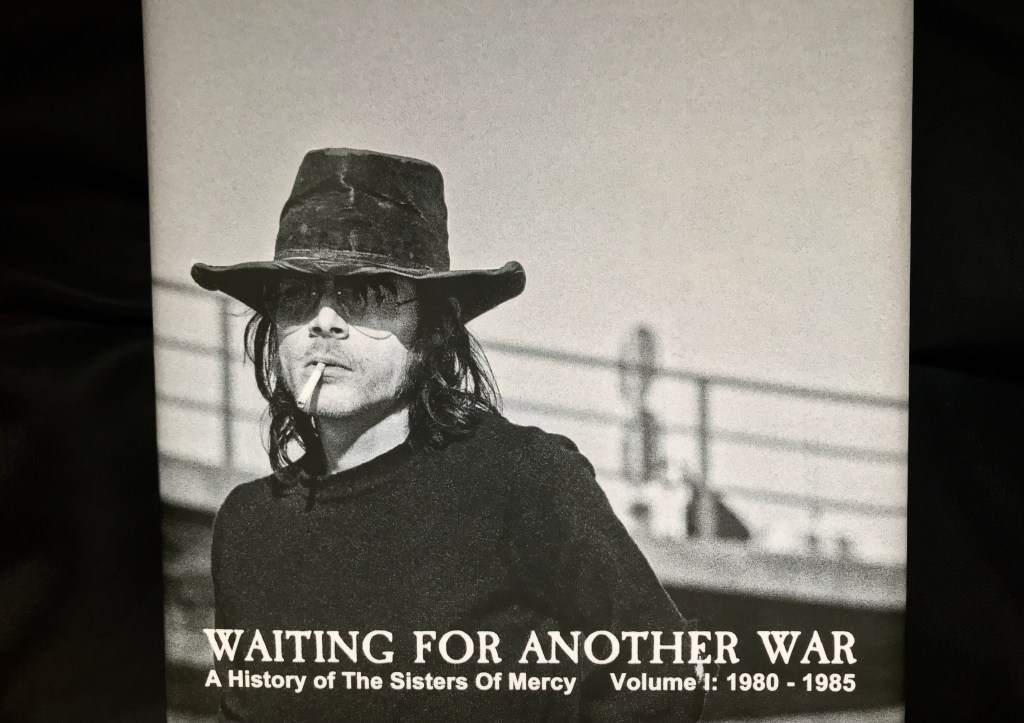
The cover shot is probably what sold us. Nothing against the book, but its existence was unknown, the abrupt arrival unexpected and there were exactly zero reviews of its content.
Stark in monochrome, Andrew Eldritch, lead singer of The Sisters of Mercy, presumably stares off toward Ulf Berglund’s camera. The aviator shades are in place so we can’t quite be sure. The $25 cattleman hat from Las Vegas is there, so is the unlit cigarette dangling just so. It’s a “morning after” pose if there ever was one, but Eldritch’s speed habit seemed to free him from the scheduled shackles of time.
Waiting for Another War – A History of The Sisters Of Mercy – Volume 1 – 1980-1985 by life-long devotee Trevor Ristow, a film and television producer and editor, continues to be met with praise and appreciation. He did the work that only the truly devoted could ever image taking on. Yet up until this point, there was no definitive guide to the early years of a band that defined a genre it sought to shun. All 200 copies of the first edition hardback, now in its third printing as of 2023 with a snippet from yours truly on the dust jacket, essentially sold out in a single morning thanks to a Facebook group dedicated to the Sisters during their meteoric rise between 1980 and 1985.
Culled from hundreds of interviews, press clippings and discussions with those who were there, the book is exhaustive and the path to publishing took decades. When I pull out an anthology of press clippings during our interview, Ristow notes that some of those scans were likely unearthed by him decades ago and included in this unattributed compilation. He’s probably right. That’s the difference between the shoe leather research Ristow did and the half-hearted scouring of the internet the rest of us may get around to – and we’re so much better for it.
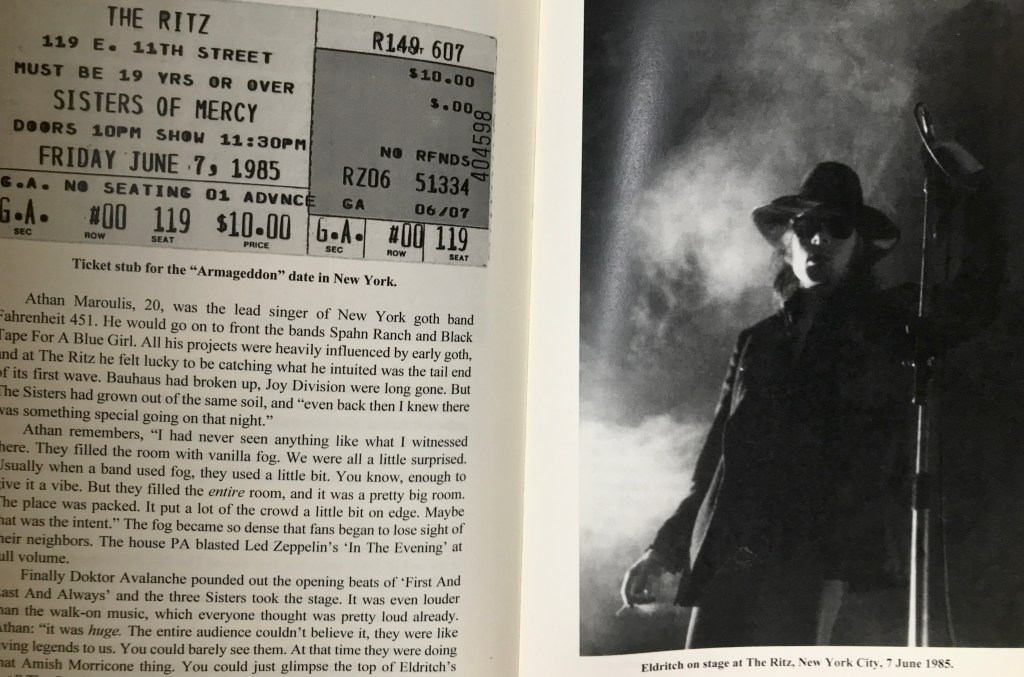
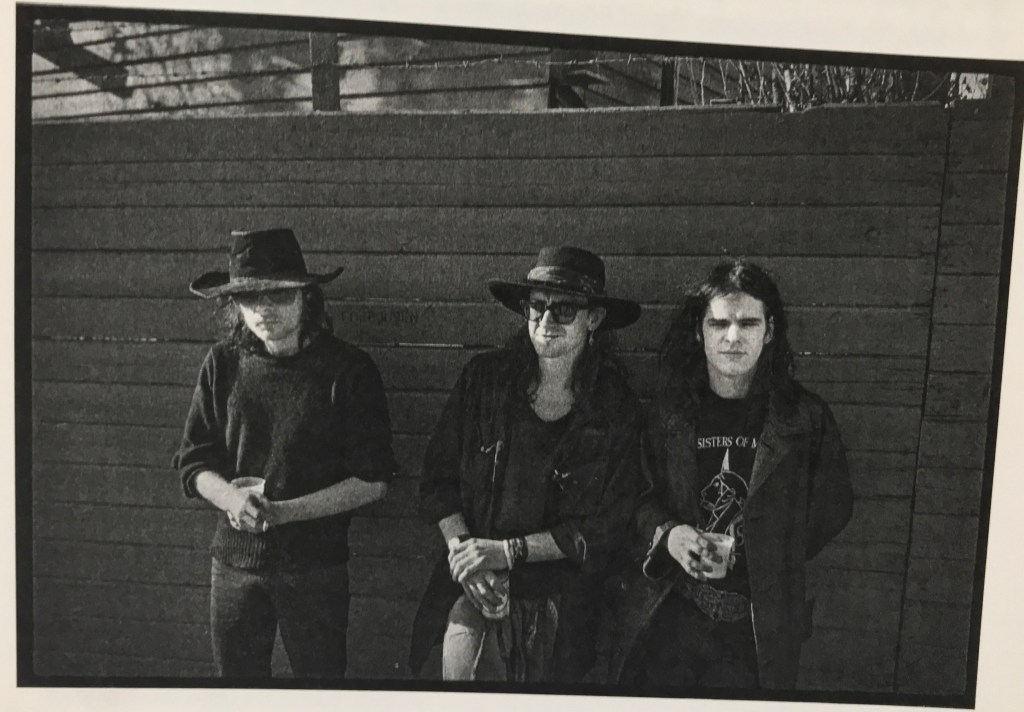
The myths and mystique surrounding the tropes of the band, as well as the inner workings of the opposing personalities within, are now given carefully researched explanations. Eldritch, it seems, wasn’t trying to wrestle control of things; his perfectionism and clear vision made him the prime candidate to handle all corporate matters while still taking his seat at the mixing desk. Hussey and Adams made the music and their frustration with rejected material helped cement their brother-like bond that still exists today. Co-founder Marx was a tier up, but his heart and head finally wandered too far off to stick it out. Combine this insight with tales from those who were there and we get a new look at these literally shady figures. The coldness, regret, moments of camaraderie and careless antics are recounted by those who a shared a bed with bandmates and were front-row regulars.
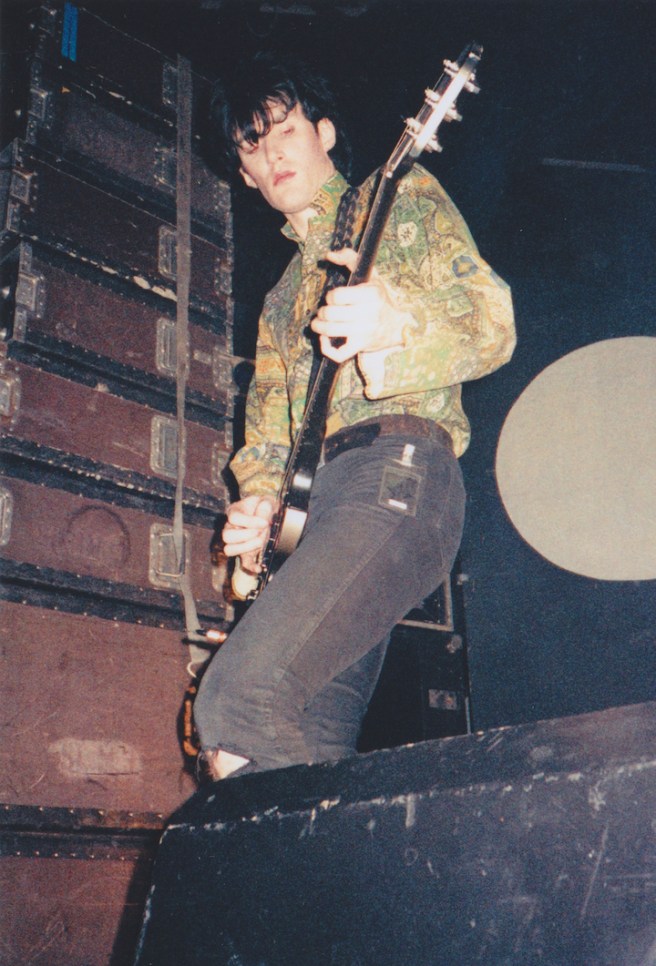
Ristow’s commitment to the cause – dating back to his teenage years and spanning the highs and lows of his own adult life – will resonates rabid fans. If you’ve ever found yourself thrilled to see a new 1984 live shot of the band just unearthed from someone’s attic, this book is for you. If the existence of a never-before-heard live recording excites you, Ristow is your man to explain the story behind the gig.
The Sisters of Mercy in 1985 embodied a state of life that called for another way of living. The heart hurts, the mind reels, the pints are empty, the ash trays are full and there’s nothing but the knife to live for. To go cover to cover here is draining and considering this life out of balance hospitalized the lead singer, be thankful it’s only a book. Moreover, be grateful that someone like Ristow was around to witness the pinnacle in person and give us this definitive history 35 years on.
Interview with author Trevor Ristow
“Every new explosion is a new attack, a new fatigue, a new affliction. Even nerves of the hardest of steel are not capable of dealing with this kind of pressure. The moment comes when the blood rushes to your head, the fever burns inside your body and the nerves, numbed with tiredness, are not capable of reacting to anything anymore.” – French military officer and veteran of the 1914 Battle of Verdun.
Gatling gun drums, muzzle flash lights, smoke, howls and an acrid smell baptized a young Trevor Ristow for battle. Waiting for Another War, Ristow’s new book about The Sisters of Mercy between 1980 and 1985, takes us to the trenches. His account of the 1985 San Francisco gig used to open his tome documents a pivotal point in the band’s timeline – and the author’s life.
Ristow readily says that he’s never been to war, but there are two things in life he’s passionate about: 19th century militaria and the band that’s exhaustively explored in his book. Precious few can say they were there to withstand the withering fire from Sisters during their definitive ‘80-85 period. So, when Ristow says the months-long World War I battle at Verdun, France is a close approximation of experiencing the Sisters at their peak, we’re just going to take his word for it.
The Sisters of Mercy have long placed emphasis on their live presence. The 1985 San Francisco show you begin your book with was arguably during their creative and aesthetic zenith. To start things off, can you describe the “powerful spectacle” for those of us who’d sell a loved one to have been there?
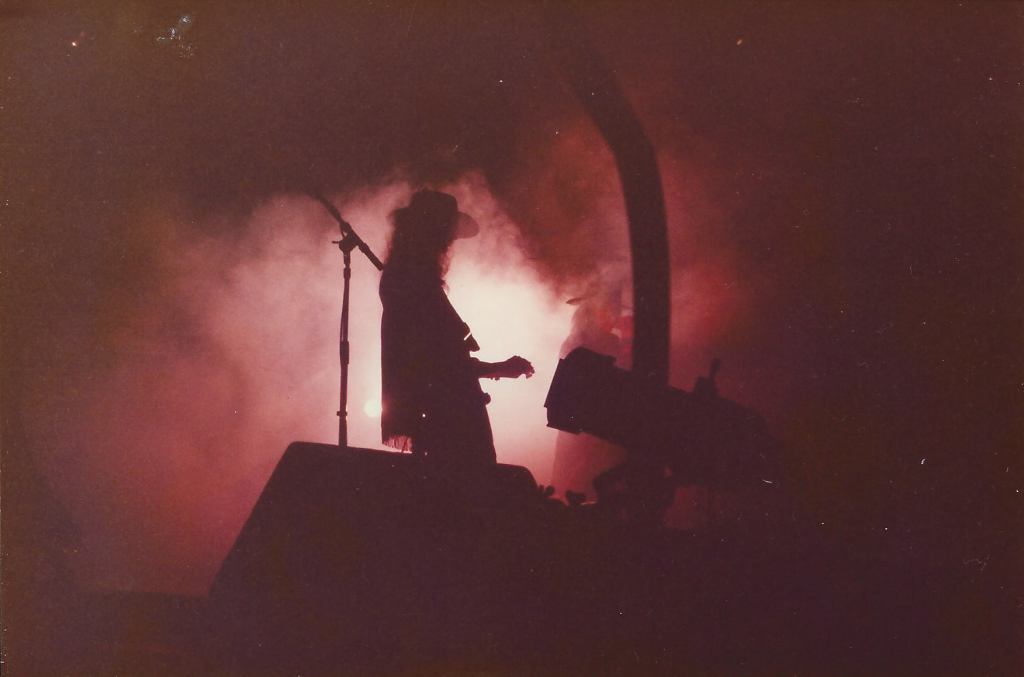
Trevor Ristow: The Sisters of Mercy were very careful about creating an atmosphere. It was equally important to Eldritch, who took responsibility for almost all the creative decisions of the band, as the music. Over time, starting in 1983, ‘84 and reaching its peak in 1985, they created this very unique atmosphere. It was sort of a mix of the Battle of Verdun and a Reinhard Sorge play. It’s a room filled with smoke with these lights that are blasting through the smoke, especially on some of the louder, faster songs like “Sister Ray.” It’s a wall of noise and this battery drum machine that has a militaristic feel to it. It’s what I imagined the people who are being shelled at Verdun must have felt, minus the being killed part of course. It’s just this awe. You’re choking in smoke. There are lights that are cutting in your eyes, the sound is just coming in your ears full volume. At the same time, you have this emotional reaction to the music. The Sisters of Mercy created that atmosphere very deliberately to create a powerful new experience for people, and it did. It worked.
I was a kid when I went to that gig and it was one of the defining moments of my life because when you’re that young, you haven’t had a lot of experiences so everything feels new. Everything you haven’t seen before feels revelatory to you. So to me, in that venue, with the smoke and the lights and the songs that I loved, the smells, it was an experience that really changed my life. It changed the trajectory of my life – it was great.
The enduring gothic rock gimmick was campaigned by the Sisters during the ‘80-85 period: the monotone vocals, big hats, dense fog and a psychedelic light show. Did they just land on the right recipe with all the ingredients in place? Or, was there some sort of calculated crafting to make the band as big as Eldritch thought they could be?
TR: Like the music, I think that the spectacle wasn’t intentionally goth because they were just trying to do something original, not create a “goth look.” They were adopting and re-contextualizing and re-imagining a lot of elements from other things. Eldritch would assimilate all of these ideas from a wide spectrum of his experience, his reading, his research into theater, rock tropes, and combine them and regurgitate them into a spectacle that felt new. I think to anyone who was around back in the early ‘80s, that spectacle wasn’t a goth standard until after the Sisters did it, and then it was copied. So it’s a trap, right? What they created was copied by other bands and people slapped the “goth” label on it. So The Sisters ended up as unwilling standard-bearers of the goth subculture, and it became something they struggled to get out from under.

Your description of Andrew’s condition just prior to hospitalization – shivering on the floor and turning blue – added literal and figurative color to an event well-known among fans. Were there moments during the writing process where you felt like you were adding meaningful context to the story?
TR: For a scene like that, the book is pieced together from probably 10 to 20 different accounts that I’ve read in 10 to 20 different interviews, or people I spoke with, even comments on a forum. I was a voracious consumer of information back then and any time I read or heard some detail that felt relevant to me, I would snag it and put it in my manuscript.
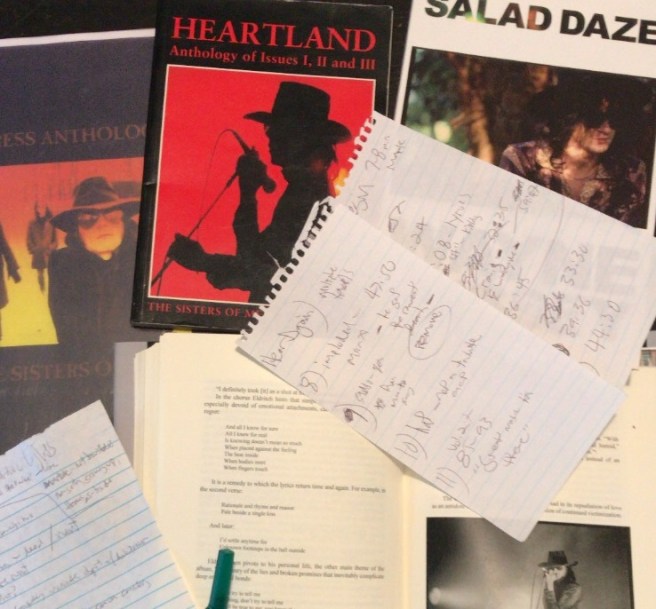
But for me, the most important context that I have added to the story of the band is in the analysis – the lyrics – because Eldritch doesn’t talk about his lyrics. You can ask him in an interview – many people have – and he generally refuses to say anything. He also doesn’t talk about his personal life. He doesn’t talk about his family. He doesn’t talk about any of that stuff. So the lyrics are mostly devoid of context. You have to confront them exactly as they appear on the page. I remember he did an interview in 2009 where he said he’ll never write a memoir. I almost put that quote at the beginning of my book, because it demonstrates something interesting about Eldritch: he communicates through his work, and pretty much only through his work. Almost in the way a dead artist, say from from the 16th century, communicates. You can’t call Breugel and ask him, “hey, what did you mean with that backgammon set?” You just have to figure it out for yourself. But Eldritch is trying to communicate something. Otherwise he wouldn’t be writing the songs and putting them out into the world. So the only way you’re going to understand Eldritch as an artist is to interrogate the lyrics. That’s the only access we have.
“A Rock and a Hard Place,” for example, was totally impenetrable to me for two decades. I mean, what the hell is that song about? Who knows? It’s very difficult to understand what that song is about. But as I started doing the book and meeting people, I would ask a friend, “Did you ever see the Sisters?” That person would say, “Oh, yes, I saw them in ’84. But not only that, I’ve got a friend who traveled with them on the road.” “Oh, put me in touch.” So you start asking around and it turns out “A Rock and a Hard Place” is actually about a particular person, or at least it starts out about a person and widens to encompass a more general experience.
There’s a great poem called “If” by Rudyard Kipling and it works on a number of different levels. It’s great verse, on the one hand. It sounds good and Kipling was very good at what he did. He wrote very well and he’s famous for it. But the poem is also written as life advice to his son, and it’s written as a tribute to this guy called Leander Jameson, who led the Jameson raid. It was essentially a freebooting raid from, I think, Rhodesia into the Transvaal with attempts to undermine the Boer government in the Transvaal, fomenting rebellion and to take over the Transvaal for the British empire basically. All of that context, that’s all fascinating.
Nick Cave does those Red Hand Files where he – well, he talks about all kinds of shit – but he occasionally offers insights into the meanings of his songs, or the inspiration behind them. What about the song “Deanna”? I love that song, but I never really knew what it was about. Well, he said, “Deanna is about this girl, and here’s her story.” So you understand the song or the poem, and you understand the artist better, if you can access the story that underlies the work.
Eldritch doesn’t give us any of that, so it’s up to us to try to decode those things. I’ve had one or two people who’ve said to me, “Oh, you delve deeply into his personal life.” Very limited push back from friends who said, “Well, I think you didn’t have to mention that.” But I left a lot of irrelevant details on the floor. I had a rule about what goes into the book. Does this help us understand the work or the band? If so, it goes in the book. If not, leave it on the floor. And I believe it’s respectful of Eldritch’s work to confront it seriously.

You note that Wayne Hussey’s 2019 autobiography helped clear a few things up. If you could have posed one question to any of the ‘80-85 members as part of your research, what would it be?
TR: I’d ask Eldritch to please explain “Down from Igor” to me. I’d ask Gary Marx if, with 35 years hindsight, he wishes he’d found a way to stick it out with The Sisters. For Wayne Hussey, this is a counterfactual that I’ve often wondered about: what could he have brought to the early studio recordings? I love his playing style and it defined the ‘84-85 period. He wrote that when he first joined The Sisters, he hoped to add some of his own style to the older tracks but Eldritch wouldn’t let him. I’d ask him which one 1980-83 track would he most have liked to re-record, and what he would have done with it. I’d ask Craig Adams to comment on the synthesized bass of the current incarnation of The Sisters, and I’d hope to elicit a rant.
Do you think the ‘80-85 iteration of the band (as a whole) accomplished its primary objective upon forming? Or, do you get the sense of unfinished creative efforts even after FALAA, which Left on Mission and Revenge could have displayed?
TR: I actually view the 1980-85 period as two distinct periods: 1980 to ‘84, end of ‘83, is the independent period. They’re an independent band, they’re trying to get going. They’re doing scrappy gigs and that kind of thing. Eldritch’s lyrics during that time are about externalities. He’s writing about mysticism, politics, religion. Just all the things that a young man preoccupies himself with at that age. He’s got songs about drug addiction, he’s got songs about propaganda, he’s got songs about religion. They’re an independent band on an independent label putting out these records. That’s the first period.
‘The Sisters of Mercy created that atmosphere very deliberately to create a powerful new experience for people, and it did. It worked.’
And then when the second period is inaugurated, three things happen: One is that they sign to a major label, WEA. Two is that they draft Wayne Hussey as a guitar player. And three, which I think is really underappreciated as a signpost of the beginning of the second era, is that Eldritch’s lyrics really shift around this time. Eldritch’s lyrics shift from his head to his heart, right? He’s had some real adult experiences at this point. He’s had some success. He’s had some relationship troubles. He’s had some interpersonal conflicts. So before, he was writing about all these things that you think about when you’re a university student. Then around the time they signed to WEA, he’s writing about his inner life and he’s writing about relationships and love and frustration and success. So I view those two eras as really distinct periods.
The second period is bracketed, I would say, by “Body and Soul” on the early side and FALAA at the end. I personally feel like that period could have gone on forever. I don’t know that the Sisters could ever have gone back to revisit the very early period where Eldritch is singing about drug addiction or whatever. In fact, in some ways, I think Vision Thing was an attempt to return to that early time when he’s just writing about the world around him. This kind of wry, detached, almost smug view of the world around him where he’s sort of commenting on things that he sees or interpreting world events. Vision Thing returns to that, let’s say, “commentary” phase. But I do suspect that his life had enough inner turmoil around 1985 to 1986 that there was probably more content for another album right after FALAA. Like everyone else, I’d have loved to get Left On Mission And Revenge in 1986. But it wasn’t to be, for all the reasons that are discussed in the book.
The “Hear Again” chapter sheds light into Eldritch’s famously layered lyrics. Do you hear the themes of FALAA – “women, drugs and roads, mostly,” as the singer once said – differently compared to your teenage self?
TR: I listen to [FALAA] all the time. Still to this day. And when I was a kid, you know, when that album came out, I didn’t understand anything about what the album meant — what the lyrics meant. They meant something to me, and the songs will always mean what they meant to me. But over time, I have grafted on top of that an understanding of what I think they actually mean. So they work on multiple levels for me and it’s a testament to the brilliance of the album that it still surprises me after 35 years
The ‘80-85 line-up imploded on itself one by one, as disillusioned members stepped away. There are a fair amount of shots fired in the follow-up albums Gift and Floodland by Eldritch, the sole survivor of the original group. Who do you think suffered the most during their tenure?
TR: It has to be Gary Marx. He’s a fascinating person to me because everybody I spoke with — and I hope this comes across in the book — basically said the same thing about him: “What a nice guy. What a good person.” You only have to listen to the music to understand that he is also an incredible talent. And he started the band with Andrew Eldritch — with Andy Taylor. In some ways, he was even more of the prime mover behind the earliest incarnation of the band.
I wish he had been able to find a way to either assert himself within the band more, or accommodate himself to the changes that were happening within the band, and stay on as a member of it as it became a much bigger concern. Much larger venues, much higher record sales after he left, but all of that is a result of the work that he put into it. Andrew Eldritch, too. There’s no question that the Sisters have to be understood primarily as a vehicle for one man’s talent and that’s Andrew Eldritch. But if you listen to the second side of FALAA, you can understand what a powerful combination of talents Andrew Eldritch and Gary Marx were. And so I think that in that sense, his departure was the greatest loss for the band in this period.
The first chapter of the second part of your book ends with a clear and forceful ode to the holy grail of goth. Do you think “that” hat is still kicking around in Eldritch’s attic today?
TR: It must be. I’m sure he’s got the hat. It’s such an iconic symbol of that period. And I also am equally sure that he will never wear it again. The Sisters of Mercy, as they exist in their present incarnation, are not a nostalgia act.
 Greg Adomaitis