Necessity, someone famous once said, is the mother of all invention. The concept to come could arguably be here to stay should popular opinion sway one way.
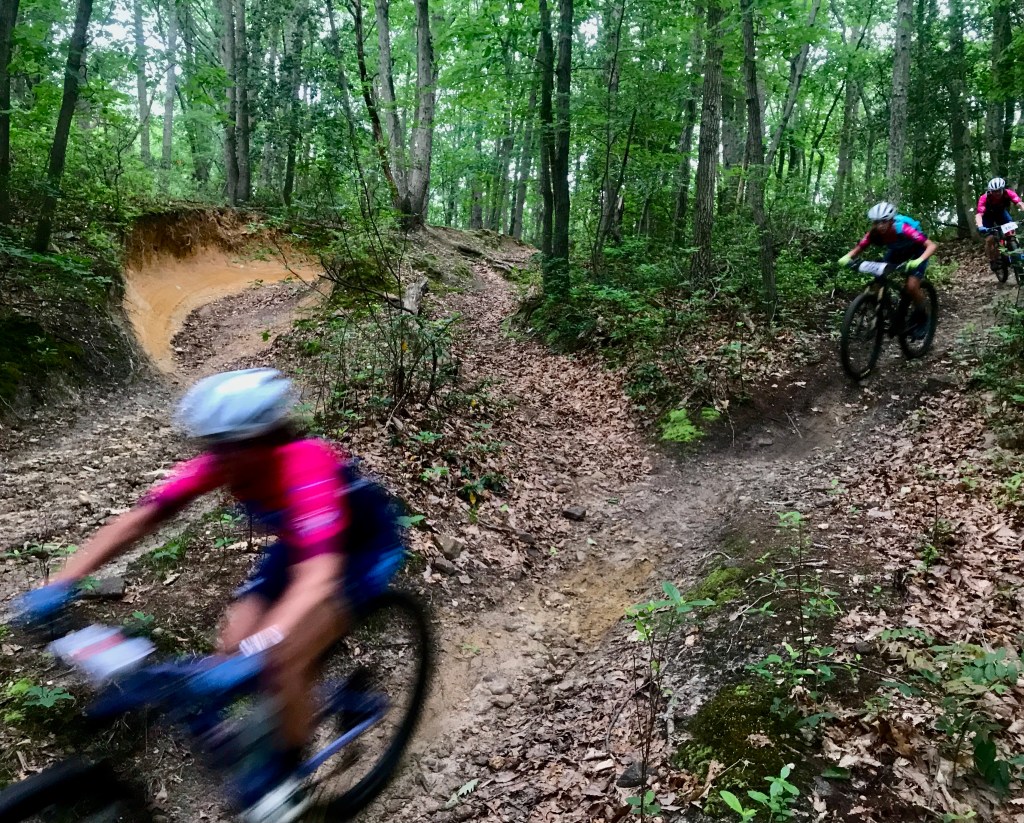
The Challenger endurance and cross country mountain bike race, held inside Camden County College’s sprawling woodlands shared with hikers, wildlife and protected plant species, is part of the Mid-Atlantic Super Series (MASS) and saw more than 300 racers turn out for its eighth edition on June 14, 2025. Steered by Race Director George Sokorai and Assistant Director Mike Trasatti, the seven-mile loop laid out by the Challenger team was as fast and flowy as the promoters promised. Thing is, that all stops short of a full explanation around an idea whose time has come.
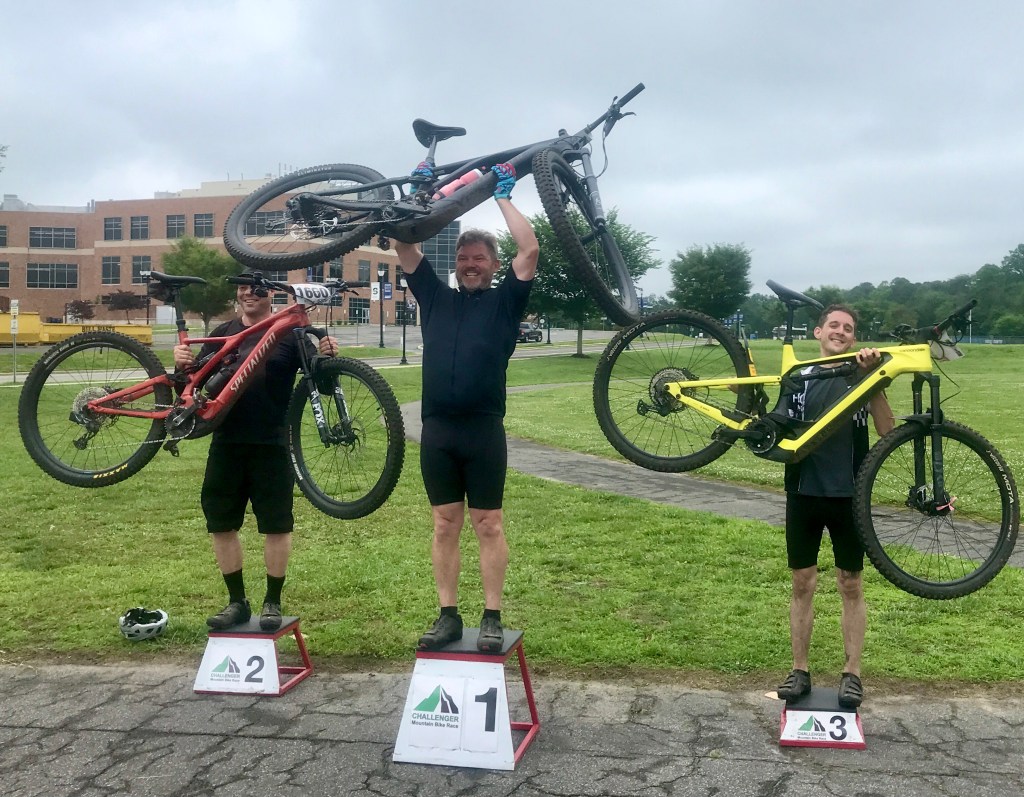
What we’d been so patiently waiting for since a February announcement was the chance to put electric power to ground in anger. So at the very end of the race day’s schedule, the first-ever electric mountain bike class that the Challenger has ever run would launch itself into either the history books or the dust bin thereof. You’ll be the judge and jury.
Get past the price tag and questionable bottom end serviceability to enjoy electric mountain biking’s free speed (to a point). But these commuting contraptions beloved by tourists and fast food delivery workers of the world are plenty polarizing among those who pay to play when they put in the hard work during bad hours. While it clearly ain’t for everybody, those two laps across 15 miles were quite possibly the most fun I’ve ever had on anything with pedals next to ripping a moped around the Mid-Ohio road race circuit (which some will surely shake their heads at and remind me that a moped is also not a bicycle despite some shared namesake componentry).
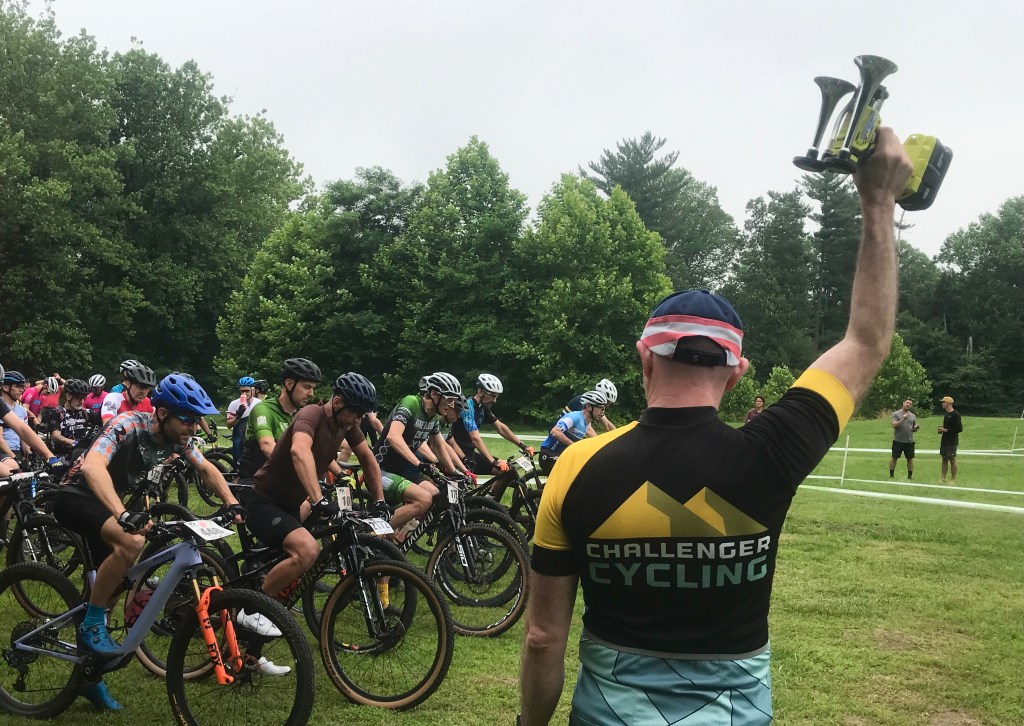
Anyone can hop on an e-bike and climb up the steepest of hills like a billy goat, but the same is never true for the “acoustic” alternative. So as our rather lonely group of racers rolled to the start sans a single spectator while the other hundred still in attendance were actively topping podiums, packing up or otherwise ignoring us motor-dopers, the words of late comedian Rodney Dangerfield gave us one good last laugh before getting down to business: we don’t get no respect.
Running Up That Hill
“Class 1” in electric bicycle terms translates to no hand twist throttle and a motor that cuts out like a brick at 20mph; the full fat of flinging a 50-pound bike is suddenly felt with boat anchor force. Hybrid touring-oriented class 2 options have a throttle (but also top out at 20mph) while class 3 doesn’t have a throttle, but are built to hit 28mph through pedal-assistance. Nine well-intention people registered for the strictly class 1 pedal-assist Challenger race. Doesn’t sound like a lot on its face, but that total is, give or take one or two, about the same count of experts and pros in each of the morning’s age classes.
One proud eMTB-er was Rick Dolbin of Aston, Pennsylvania who gets full credit for the gallows humor Dangerfield joke above. Sitting at the bottom of the “Cheeseman Chute” downhill slingshot and cheering on the morning’s endurance and Cat 1/Pro racers, his Canyon eMTB was propped up against a tree and out of harm’s way. The admitted recovering smoker on a weight-loss journey who loves riding but “wasn’t having any fun” going “4 miles an hour uphill” discovered electric-assist through rides with his brother. He never looked back: “I was ready to quit. I dreaded those hills. It saved the whole thing for me.” Dolbin took a pre-ride of the county college loop earlier in the week and hit it as hard as he could. “I was huffing and puffing.”
Chris Hubbard, from Bel Air, Maryland, has an extensive bike racing background and the legs and lungs to clean up in his Cat 2 age class. “I enjoy the challenge of climbing up the hill. Going down is obviously more fun, but I enjoy the process of training. It gave me extra motivation in life,” he said. That means three to five hard rides every week, grinding it out when you deeply don’t want to, but are starting to see and feel the gains from doing so. For Hubbard, who has regularly done gym workouts since high school, time and effort translates to a distinct payoff on race day. Asked about the elephant in the war room: “E-bikes allow you to go for a ride when otherwise you’d be too tired,” he said, adding that they are a “great training tool” and help “bridge the gap” for some group rides of mixed company and skill.
Pain, others have mentioned, is weakness leaving the body and this is probably near the peak of polarizing eMTB problems: you can’t fake it in bicycle racing. Either you’ve put in the time and can drop the pack, or it’s a heaving slog while swearing you’re going to start riding more come Monday. I’ve been happy enough to just get a whiff of respectable results at places like Fifth Street and Sly Fox and the misery of bell lap cyclocross will always be something special to me. You know what else is rewarding, though? A weekend afternoon spent at speed when the logistics of an internal combustion-powered ride aren’t panning out, but you still want to spin the ol’ rotor ’round the stator and spark some excitement. Here, familiar names like Bosch, Fox and Yamaha tangle with the likes of Cannondale, Shimano and Specialized and there were more than a few active off-road motorcyclists in the Challenger’s eMTB race. It’s by no means a pre-requisite, but the lines blur at the bleeding edge.
To that end, the American Motorcyclist Association’s Grand National Cross Country (GNCC) series is the premier frontrunner for traditionally motorized woods racing. Seizing an opportunity and seeing evident crossover in its audience who’d just as soon buy GasGas or Husqvarna pedal and petrol-powered items, the 10-round eMTB series capitalized where event names like “The John Penton” in Ohio and a visit to Mt. Morris, Pennsylvania, home of High Point Raceway, are not lost. Now, a points-paying AMA championship is pretty high on the cultural relevancy scale and here’s a list of rules and regulations to get an idea of how seriously the segment is taken.
Other electric-assist races planned for the rest of 2025 across the Mid-Atlantic region include the Pig Iron, Steel City and Iron Mountain enduros and Sokorai said promoters are eying the possibility of a MASS series next year. In theory, running an hour-long race at 8 a.m. would still send the endurance and XC pros off at 9 a.m. and allow any brave Cat 2s and curious Cat 3s to double up on entry fees and run both classes – but I’m just spit-balling here. It would also force some eyeballs on this first race of the day, but I’m only further digressing.
A Turning Tide
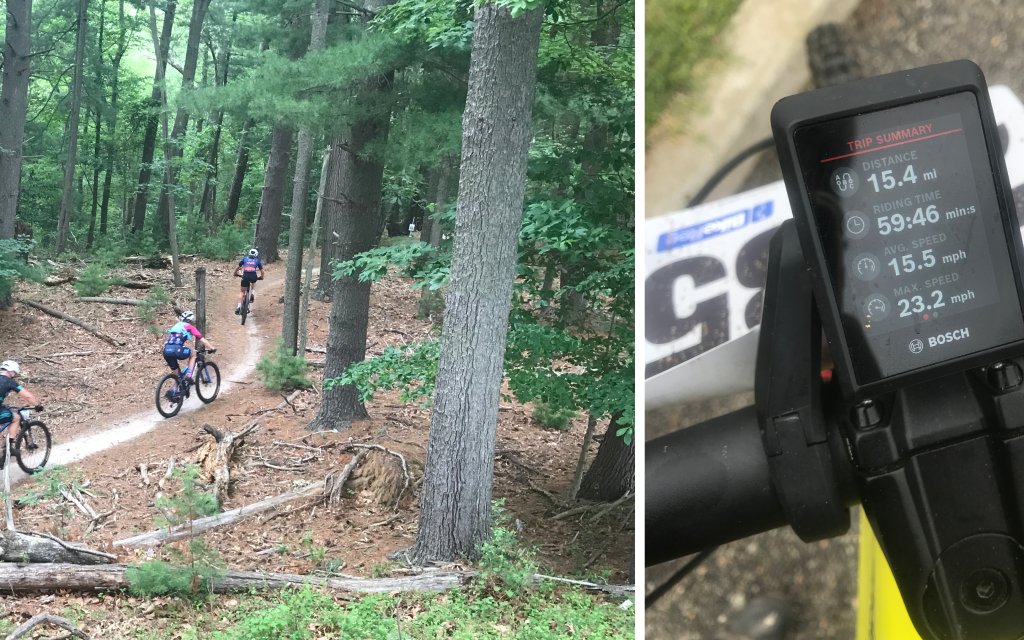
A light race day rain had finally moved in and never really moved on. Blackwood’s dense tree cover protected these sandy trails carved out long ago, but their exposed roots became beyond treacherous. So, too, had the 180-degree hairpin first turn from the starting line as the sharp edge of things flew four wide into it before taking off toward the whispering pines and never letting off the… er… gas.
Gaps continuously opened and closed during a fast and dynamic 19 miles an hour. I clipped a tree and had to dig deep, well after the motor’s assistance had signed off, to hold off the guy barely a bike length behind me. I watched with jaw dropped as a rear tire torqued itself free of grip on a slick wooden bridge, launching the rider and bike onto the upper banks of the stream beneath. The rear shock sucked it up and the competitor powered out without losing a beat – or his second place position I was gunning for. Now that’s racing, and it took me too long to learn how to stop worrying, leave the deep section tubulars at home and just enjoy the ride. A 2025 Outside magazine article titled “Should We All Just Submit to Our eMTB future?” lays out how far the technology has come in the past decade, how much of the market these machines are eating up and the advantages to growing the segment through folks who’d otherwise never give it a try.
There’s moto history in these very woods and while that means squat to some, electric MTBs flow in a vein that taps both tradition and brand-new two-wheel opportunities. At the end of a long planning process and longer day, race director Sokorai shared a moment to reflect on another successful edition of his race – and that ever-important first-ever electric class. Be sure to read his backstory with bikes, nagging knee problems, a forced gap and then deciding to pick up a Specialized Turbo Levo from Action Wheels, in nearby Wenonah New Jersey.
“Typically, I’m the guy who likes to push the envelope, advance the sport and get more people involved,” he said. “With new technology, it’s either embrace it or don’t. Look at mountain bikes. We used to be blamed for tearing up the trails – now we’re the ones taking care of the trails,” he said, adding that a few bad apples who might ride electric offerings a bit too fast for places shared with foot traffic can have an inordinately negative impact on larger perspectives around respect.
Most everyone these days is deep in the power struggle trying to figure out if or how an electrified future plugs more lithium into their lives and eMTB’s growing pains are no different. “The tide will turn,” Sokorai surmised. “It’s just a matter of where and when.”
 Greg Adomaitis