
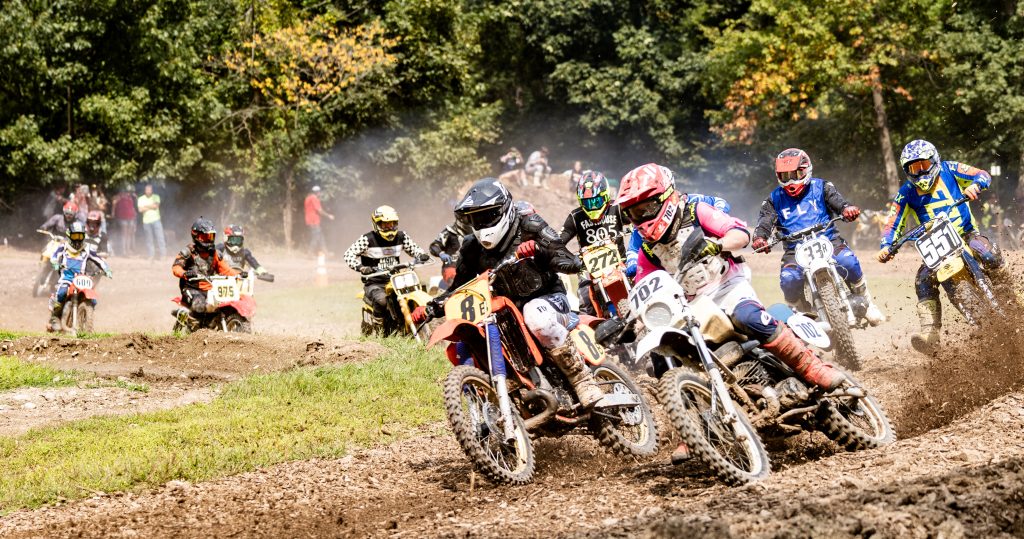
There’s this great paradox in power sports racing. For those brief blips of bloodthirsty speed, we endure hours of dulling dawn-to-dusk interstate travel.
This is the case for modern machinery, too, but it’s twice as true for vintage enthusiasts going through the growing pains of trying to get an all-new venue on the annual schedule. Finding an agreeable land owner, sympathetic business operator, suitable property and calendar flexibility – with all the race day prep on top – is as time-consuming as it sounds. So when word was floated last fall that there might be a vintage-friendly event a relative stone’s throw from home base – and considerably closer for those in the northern Philadelphia suburbs – the guarded anticipation commenced.
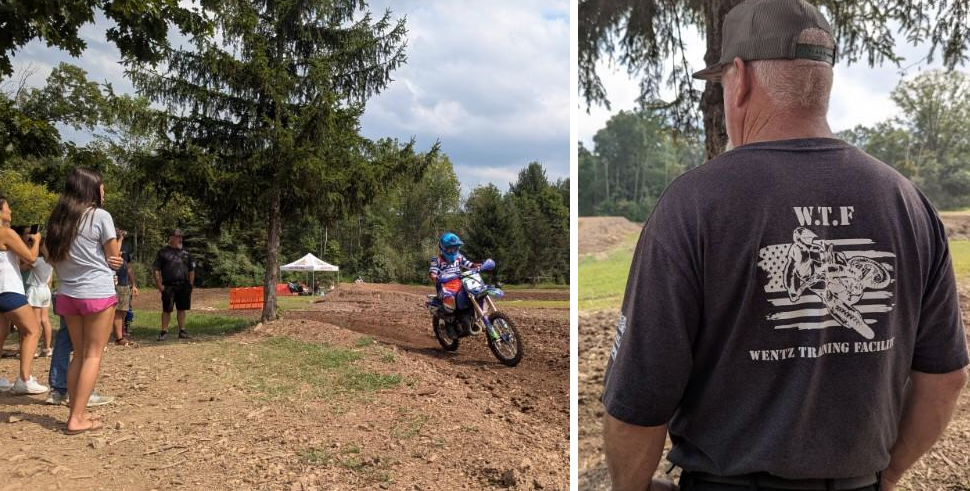
“For five or six years, I’ve been asking at riders meetings to find me some property in Maryland or Delaware,” AHRMA Mid-Atlantic Coordinator Dave Kutskel said. “For years,” he emphasized, “we’ve been trying to find a race out east.” Through an unplanned encounter and much sweat equity on all fronts, Pennsburg, Pa.’s Wentz Training Facility (WTF) opened up the front gate for a real-deal race course and country-crossing trail rip.
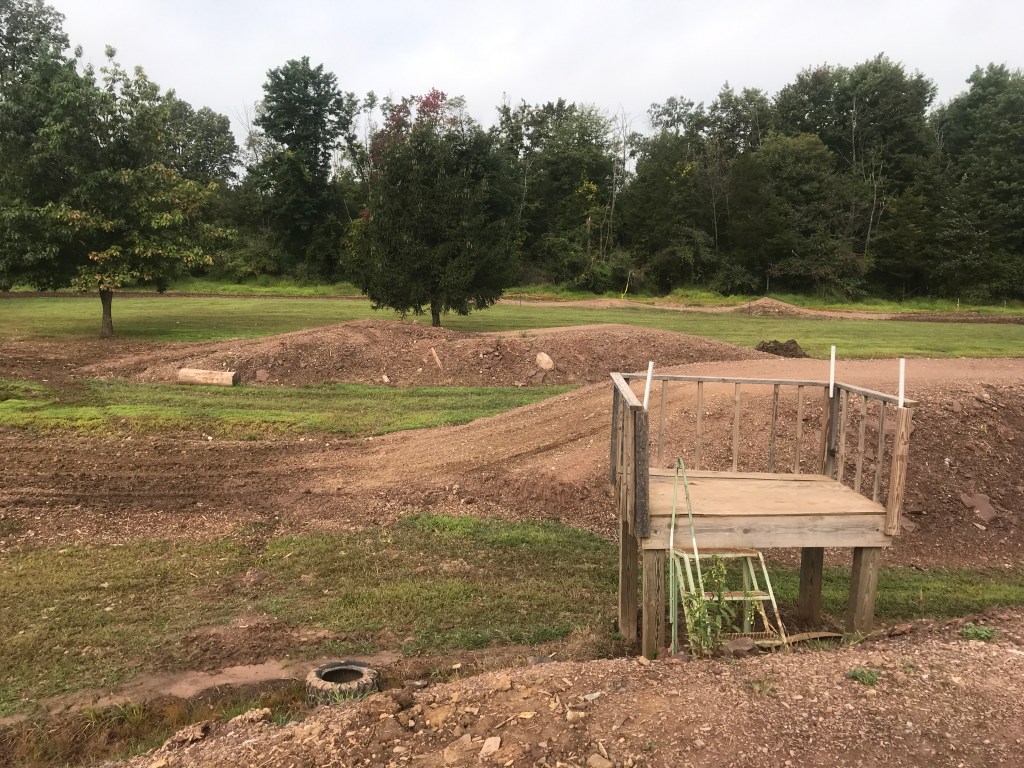
Home Field Advantage
After incredibly dry rounds at Vermont’s State Line Riders and New York’s Bear Creek, the Sept. 6 and 7 combined Mid-Atlantic and Northeast motocross and cross-country races at Wentz were a welcome – if not a slight bit soggy – reprieve. Helmed by husband-and-wife duo Kain and Terral Wentz, this private compound took shape in 2020 as their teenage son learned to ride a dirt bike and the family “started building one trail after another” before they eventually “opened it up to family and friends,” Terral said. AHRMA racer and event trail boss Joshua Schucker explained that members of his local enduro club attended an on-site training class in 2024. The possibility of a vintage event was eventually floated and, through more than a year of planning, logistics, scouting trips and all manner of coordination, the pieces to pull this weekend off slowly fell into place.
Kain, hard at work prior to motocross practice running last-minute earth works to get the track into shape, said he was excited for this first-ever AHRMA event and what he hoped “should be a fun day.” Having just recently hosted a Temple Off-Road Racing (TOR) round that drew 631 competitors with 1,100 heads through the gate, the 151 VMX entries on Sept. 6 (including a half-dozen AHRMA first-timers) were a welcome chance to catch his breath. “With WTF hosting a TOR modern race in mid-August, we really didn’t want to put a lot of time into clearing trails and formulating the course until we knew where that race’s loop would be established and if it interfered with some of the prior rough draft work done,” Schucker said.
‘For years, we’ve been trying to find a race out east.’
“Once we learned the TOR course the week before that race, we set to work on rediscovering ribbons that were hung in spring and brainstorming how to connect it all together,” he continued. “Lots and lots of vegetation from a wet year made finding some of that ribbon a challenge.” The efforts to lay out the cross-country loop included work by members of Reading Off-Road Riders, South Penn Enduro Riders, Valley Forge Trail Riders, Potomac Vintage Riders and dozens of other individual contributors and AHRMA volunteers, with some coming from as far as Ohio to help.
“If it wasn’t for him, we wouldn’t be here,” Kutskel said of Schucker and his efforts to work with the owners and lay out the 4.5-mile loop. Shucker in turn thanked the Wentzes for being “extremely open, communicative, and accommodating throughout the entire process and always looking to help with whatever was needed in prepping the MX and CC areas.” Asked at the end of day one for his thoughts on how things went, one could sense the relief and sincerity when Kain Wentz reflected on very nice weather and very fierce racing.
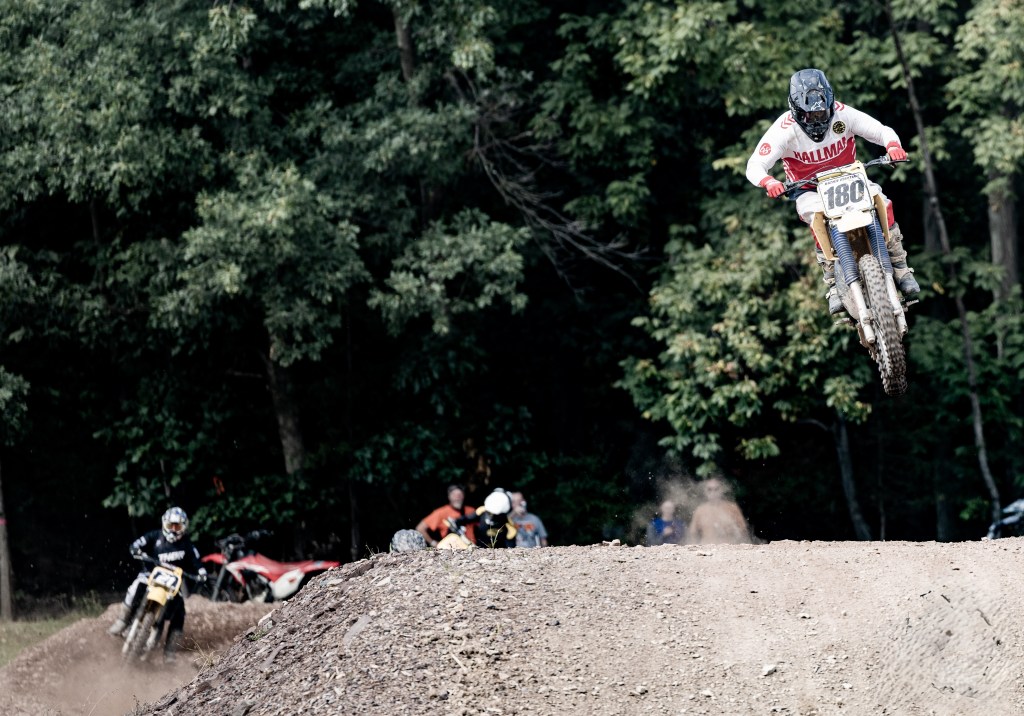
Columbus, New Jersey’s Michael Cramer, a South Jersey Enduro Riders club member who raced an ’86 CR250 for cross-country on Sunday, described the course as a see-sawing succession of challenging single-track, relentless 90 and 180-degree turns across elevation changes and a “chance to pop out on the motocross track straight leading you into three tabletop jumps where you could exercise the throttle and get some much needed air through the radiators, if you had any, then back into the woods.” All in all, the loop “rewarded clean turns more than charging out of corners.”
The vintage crowd is a generally easy-to-please bunch and between the “great dirt, great weather and great camping,” Cramer could have hardly asked for anything more – certainly not the hour-and-a-half commute time. “The long hauls from home aren’t always a deal-breaker, but it does make the weekend a little more of a marathon. I am a vocational teacher at a technical high school so taking Friday and Monday off aren’t really an option and getting home at midnight or later and waking up to teach students automotive technology can be a challenge,” Cramer added.
What Price Glory?
Now don’t get me wrong: most everyone has a “home” track. There’s nothing novel about that concept in and of itself, but here’s the thing for us Delaware Valley folks coming from the core of the most densely populated state in the nation. The typical vintage meet is at least three hours one-way and the “closest,” at approximately 100 miles and two hours out, still constitutes a haul. So forgive us Garden and eastern Keystone state folks for that extra pep in our step as we arrived at WTF bright-eyed, bushy-tailed and to the tune of the world’s tiniest violins.
Chris Breithoff, who lives 8.8 miles away, said “leaving at 7 a.m. and getting here at 7:15 a.m.” was hard to beat. “I hit a red light on the way and it pissed me off,” he laughed. Pownall, Vermont’s State Line round, a five-hour drive for Breithoff, was his farthest hike in recent memory so he’s no stranger to sacrifice – but this one was a welcome reprieve from the grind. Ron Krzaczyk, of Doylestown, Pennsylvania, had a mere 45-minute drive to the Wentz compound. Sitting on the bed of his pick-up next to a hopped-up 1974 YZ250A, a bike that scares him into hanging on for dear life in a good way, he said race weekends are expensive enough and the hassle of commuting had really cut into his participation percentage this year. He’ll still hit Allen’s Farm annually, and his favorite is Lamoka, but getting out of bed at 6:30 a.m. and still being on-time for a 9:30 a.m. riders meeting was hard to beat. “I had this one planned on the schedule,” he said.
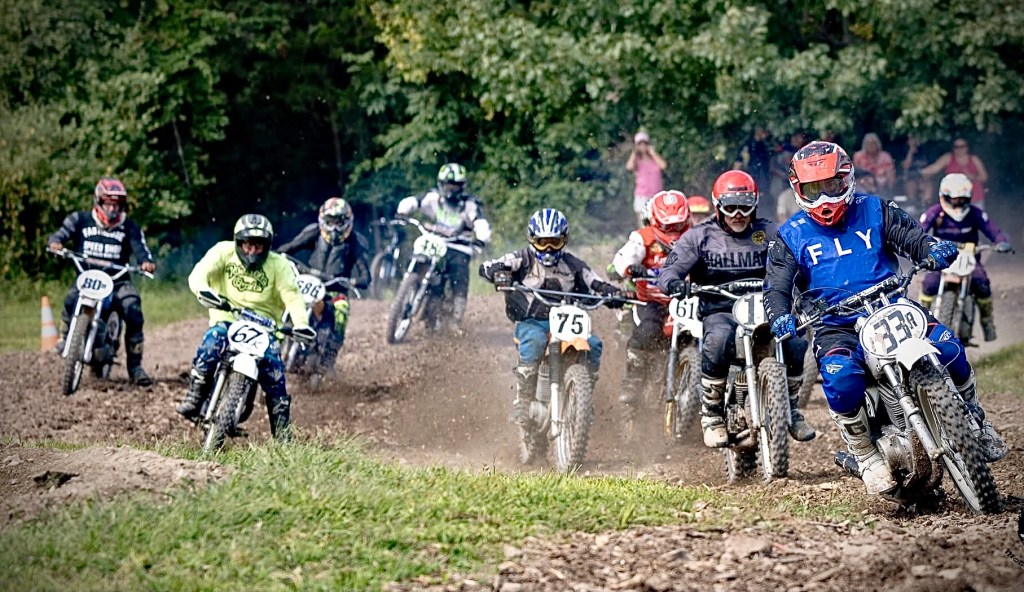
The Wentz motocross course was an eye-opening skills check compared to the wide-open power section grass tracks that host many AHRMA favorites. This was a jump-laden, rutted-out, whoops-section to on-the-gas then on-the-brakes tight and demanding loop. Some would call it a “cornering clinic” in bicycle racing. As my front end knifed over in a deep groove and the ground started rising up to deliver a face full of wood chips mixed with Montgomery County’s finest top soil, I’ve still got some learning to do.
All told, it was a tamed-down version of a modern course with just about every imaginable feature packed in and that’s what Wentz deserves commendations for. Kutskel noted that in talks with the facility operators, leveling with them as one enthusiast to another, nobody in the vintage scene was going to get rich as event planners and race promoters. As such, it’s all too easy to say “no” to vintage event proposals. If the earth-moving equipment is going to be called upon to turn the doubles into table tops for a single day, as to spare bikes and bodies not so easily repaired, it’s going to need to make dollars before sense.
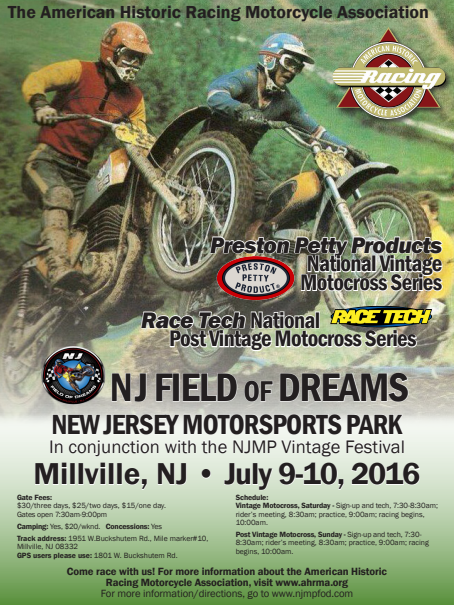
“People out east, they have no place to race,” Kutskel said of VMX opportunities. Millville, New Jersey’s Field of Dreams facility hosted an AHRMA motocross national in 2017 with an “MX Rewind”-like schedule (vintage racing on Saturday with post-vintage and modern on Sunday) but has long since fallen off the schedule. Englishtown, New Jersey’s Raceway Park – foundational in the formation of Garden State dirt bike racing – was also a long-time host to annual vintage events (see these 30 minutes of 1994 footage for proof) but has similarly faded away from “Vet and Vintage Reunion” events held as recently as 2021.
AHRMA organizers had previously approached Budds Creek, deep down in the Mid-Atlantic region of Maryland, but couldn’t strike a suitable deal with the outdoor pro nationals track. Ezra Beasley, the facility’s second-generation family operator, explained in a September 2025 interview the logic behind how he books out races and practice days. It boils down to a simple math equation: a predictable count of expected sign-ups weighed against the ever-rising operational costs of fuel, insurance and paying on-site staff. “Even if I wanted to, I can’t afford to lose money on an event,” he said of doing something that’s good for the sport – but watching the rainy day fund take a sizable financial hit in the process. “The profit margin is smaller than people think.”
Four-wheel ATV racing, he added, “is very much in the same boat. The people who are into it are very passionate about it, but it has to get more people into the sport.” Annual “grassroots” events that see ever-dwindling attendance due to, for example, increased class fees or longer drive times because of few-and-far-between options becomes a sort of “self-fulfilling prophecy to the bottom,” Beasley said. Well then… any solutions? “You want more places to ride? Support what you’ve got to see it grow” because the possibility of locking down a future vintage event at Budds Creek comes right down to the amount of people you can prove who’ll turn up.
‘Even if I wanted to, I can’t afford to lose money on an event. The profit margin is smaller than people think.’
Sure, one could ride a relatively modern bike and support these close-to-home tracks – which I have done, and thoroughly enjoyed. It’s just that one’s tolerance for nearly being landed on by leaping “college boy” classes gunning for that pro moto meat grinder drops precipitously as age rises. All I know for now is that two things can be true at once. First, the American Retrocross club has a monthly vintage event at San Bernadino, California’s classic Glen Helen Raceway. Second, this track and its sweeping right-hander was a long-time outdoor pro national venue that Motocross Action magazine still spends a lot of time at covering local races and testing new bikes. Cramer, the ’86 Honda CR rider from South Jersey who also pilots a late friend’s 2019 Husky, is no stranger to East Coast Enduro Association “modern” events when helping run his club’s annual hare scramble and dual-sport. When it comes to seat time (and that’s the bike saddle, not driver’s seat) Cramer sees it this way: “Getting to the races is more about getting together with my friends nowadays than it is the competition.”
If there are wills, there are always ways to get there. For now, we’ll keep crossing our fingers for more schedule shake-ups that favor the far-east crowd. Until then, here’s hoping the Wentz gang welcomes back the vintage contingent next year. Like they say, good things come to those who wait.
 Greg Adomaitis