
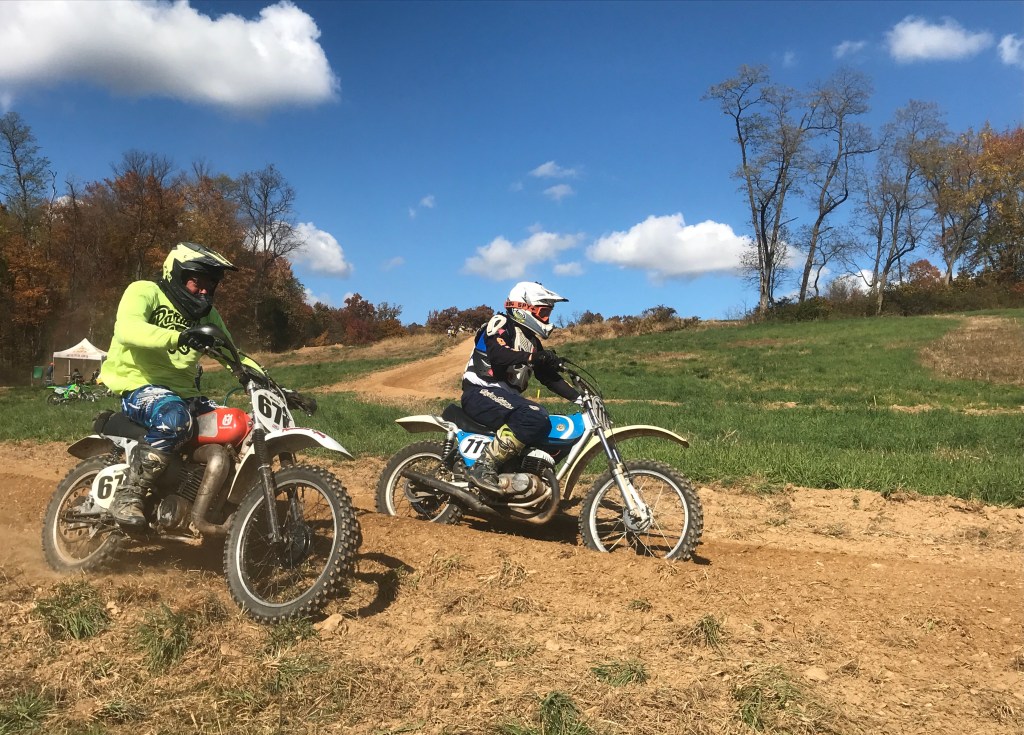
Some are built on the sides of mountains. Others hide inside private property. More are laid down just above the water table. All of them have one thing in common.
That shared quality is Mother Nature and Father Time working in tandem long ago to create the grass tracks of vintage motocross. The infrastructure is minimal here and the concept is touted as a fast and friendly form of rain-or-shine weekend warrior racing. But the roots grow a lot deeper than the surface-level green ground cover that gives these events their namesake.
Truly “vintage” off-road racing is defined by AHRMA as the “period of international recognition” after World War II. This transition began with scrambles competition across European countrysides aboard “basic transportation-based models with slight modifications.” It would give way to global Grand Prix warfare right up to the mid-1970s with its “specially designed racing machines on specially prepared tracks.” This window of time “is considered to many around the world as one of the greatest eras of the sport,” the AHRMA explainer continued. “We want to show why this is said.”
And I wanted to know what it all means to those who, season after season, turn up to churn up no man’s land.
Natural Inclinations
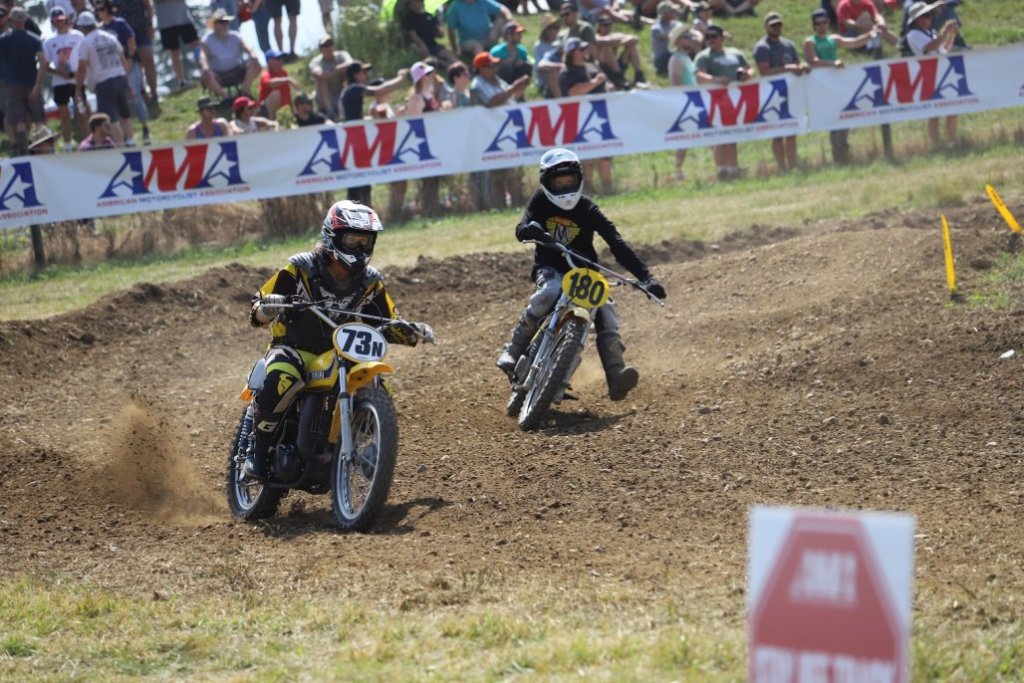
The quick history lesson above was somewhat necessary to help set the scene, as these high-speed races of yester-year often took place over farmlands and made use of deceptively difficult natural features, such as off-camber turns, bumps, stumps and jumps. They were plenty challenging while not asking too much of the era’s suspension technology. Moreover, the whole package helped inform the riding techniques required to traverse this type of terrain while still remaining upright.
Said another way, it’s the perfect place for an Elsinore to chase down a Pursang at full chat across a wide-open straight leading into a dirt chicane. These sights and sounds are AHRMA staples, but the AMA’s annual Vintage Motorcycle Days gathering similarly touts its MX circuit on the infield of the Mid-Ohio Sports Car Course as a “period-correct grass track with modest table-top jumps” that has been “tailor-made to suit classic motocross bikes” without a “double or triple jump in sight.”

Take that lively experience for riders, give the spectators a nearly complete view of the field as it unfurls and set the whole thing against a scenic backdrop to see how and why the allure still holds. Such was the scenario at White Rose Motorcycle Club in Spring Grove, Pennsylvania, which has been the long-running host of traditional season finale races for Northeast and Mid-Atlantic AHRMA motocross and cross country. The 2025 running saw 250 MX entries across 19 heats and the course itself, lead race organizer Brett Reichart explained, circulated around a former farm field and took advantage of a single ridge line’s natural elevation that helped give the historic hill climb here its footing.
“There are only four places where you fly,” Reichart said. “It’s not overly prepped – it’s just a marked course in a field.” Even with that humble assessment of what proved to be a very fast and flowing loop, the production required about two full days of work to mow the motocross layout, disc the dirt, 3-D print about 200 course markers, plus enlist the help of various family, friends and volunteers like Tim Cranston who used a skid steer to finalize jump structure. Once that was completed, no rest for the weary, as it was time to trace the whole cross country trail. “It’s a really good environment for someone who has never tried racing,” he said of grass track races and the types of people who come out to compete, spectate, hoot and holler. “It’s a good way to get into the sport.” Speaking of which…

One for the Ages
When it comes to increased event turnout, running some youth fields can help turn things into a family affair. Dave Meakem, from Monmouth County, New Jersey, had his 5-year-old grandson as riding partner at Allen’s Farm this past July. Like many do these days, Jayson started out riding a Stacyc electric balance bike two years ago and then graduated to the ubiquitous PW50 for his first-ever race at Allen’s Farm. “He’s so excited, he couldn’t sleep last night,” Meakem said. “This,” he gestured, “is vintage motocross. The tracks are safer and attitudes are more laid-back. It’s really good racing for everyone.”
“That’s what it’s all about,” long-time event host and promoter Jim Allen said of the levels of accessibility. “I think the kids are the greatest part of it.” The natural terrain here in Lawton, Pennsylvania offered a two-tier experience. The upper deck consisted of rolling hills into banked turns while the lower level was purely power sections. It worked well for the roughly 150 entries and that goes for both adult competitors and the younger ones, as the bits that can spell trouble for even veteran experts have been smoothed over. “There’s no flying through the air. They’re gonna fall down no matter what they’re doing,” Allen joked of the 50cc fields who are still actively establishing their centers of balance.
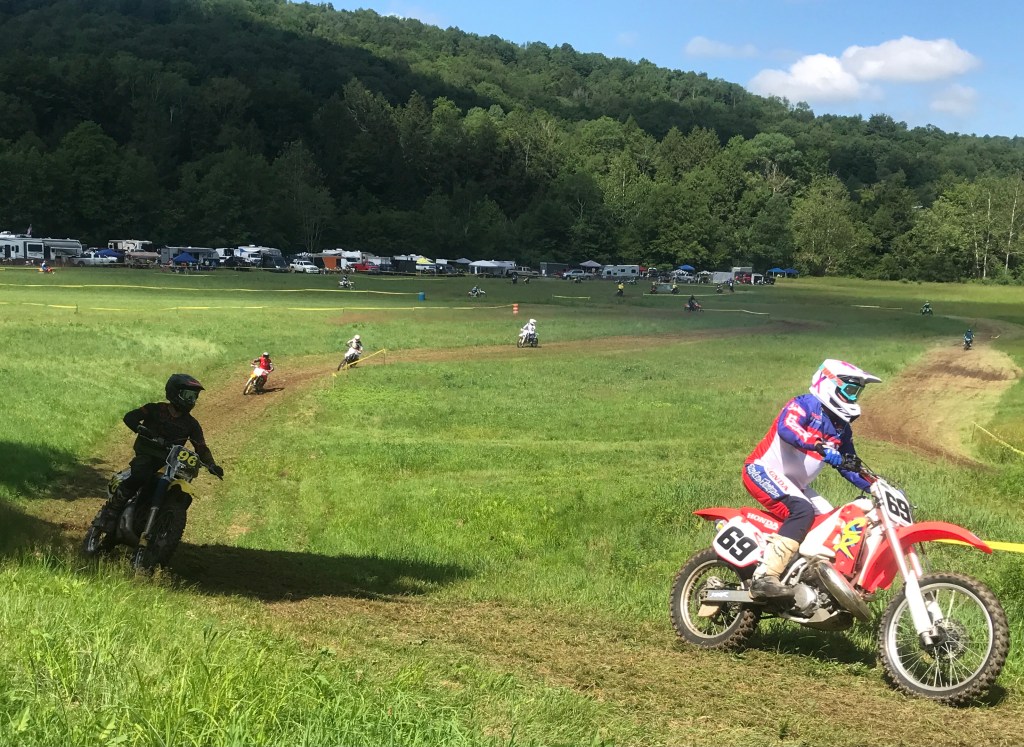
Few know it better than Howard and Lisa Grove, who help run the Team Frankenstein youth vintage racing non-profit organization that offers affordable classes for boys and girls as young as six years old and right on up to 15. (It should also be noted that these racers often receive the loudest applause at the day-end awards presentations that round out every race day.) The organization’s name, understandably, comes from the Frankenstein-ed Honda SL100s that were cobbled together for the group’s first young competitors so many years ago when the effort was founded in Ohio. “We enjoy watching these kids grow up. As a non-profit, everything goes back to the kids,” Howard said.
Another for the Record Books
With the 2025 Northeast and Mid-Atlantic racing season all wrapped up, a little reflecting on the past six months never hurt no one. Eastern Region trustee Jeff Oakley, getting ready for a long-since done and dusted moto at Allen’s Farm, explained that vintage is “about the people you meet along the way” while AHRMA is “all about presentation of ‘back-in-the-day’ and it was grass tracks back in the day. This is preserving the history and the heritage of the sport.”
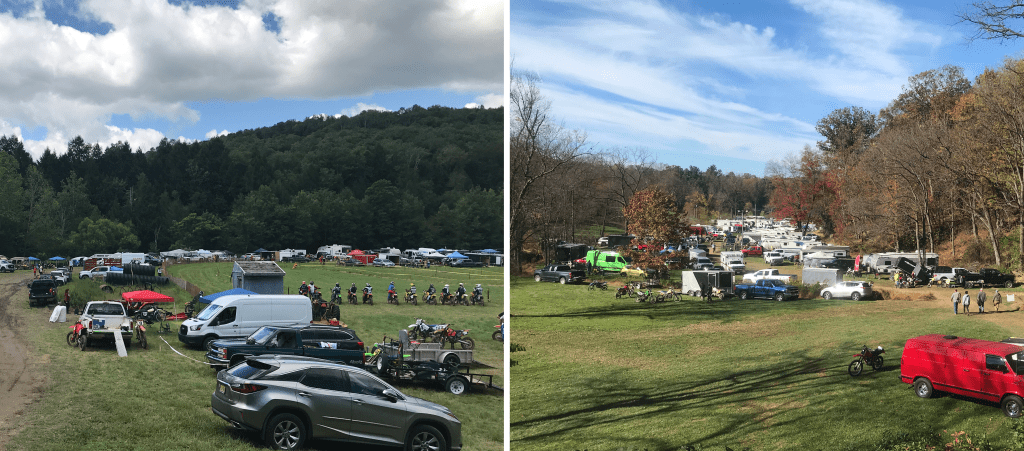
Before domestically dominated Supercross filled football stadiums, there were Belgian iron men fighting for continued supremacy against incoming Japanese speed kings atop some corner of American soil that’s forever a part of motocross history. This brief blip, merely a moment when natural grass tracks were pretty much the only tracks, was as narrow as a 125’s power band. It’s also what AHRMA’s motocross mission statement, worded tighter than a factory-fresh crank, summarizes so well.
Their rule book’s parameters to preserving the elements of this “bygone era,” all those sights, sounds and strategies of trailblazing racers, hinges heavily on the setting itself. With a sea of spectators lining the start, the rubber band snaps and a full gate begins pulverizing the lay of the land so that “these machines will never become obsolete again.”

 Greg Adomaitis