
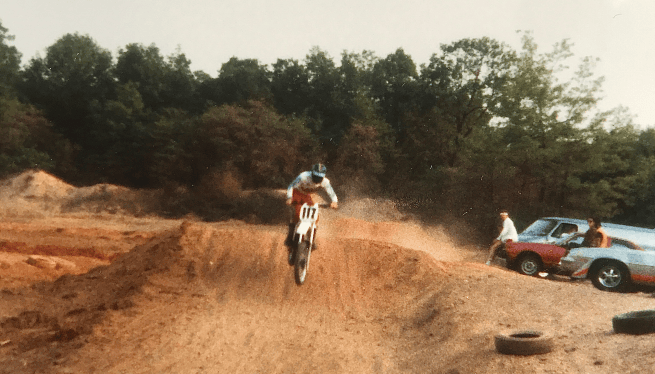
From the crumbling edge of a hole in the world, everything that ever was, and could have been, stretches out before and beneath me.
First were the glorious years of free will riding. Then came the sudden external pressures that so often crush a good thing. Finally, the burden of burying the albatross that was this barren battlefield. Here, a holy trinity of past, present and future spans a half-century while simultaneously existing in a baffling single second of time.
The list of long-lost tracks runs from coast to coast: Aquasco, Pepperell, Puyallup, Steel City, Kenworthy’s, Speedworld and Indian Dunes to name a few casualties of war. Those out west still lament the loss of Carlsbad and Saddleback, the former a scene of many live televised races on ABC and the latter re-opened to hiking and mountain bike traffic as a nature preserve – but still a far cry from its motor playground peak. These places fell victim to everything from proper permitting and land sales to environmental and noise concerns. Others like Honda Hills and Zoar Valley died, but were revived with various odes to what once was.
Way down on this list was a briefly used mining pit where the rain of red grains inside the hourglass had all ticked by long before my time. It was called Blackwood.
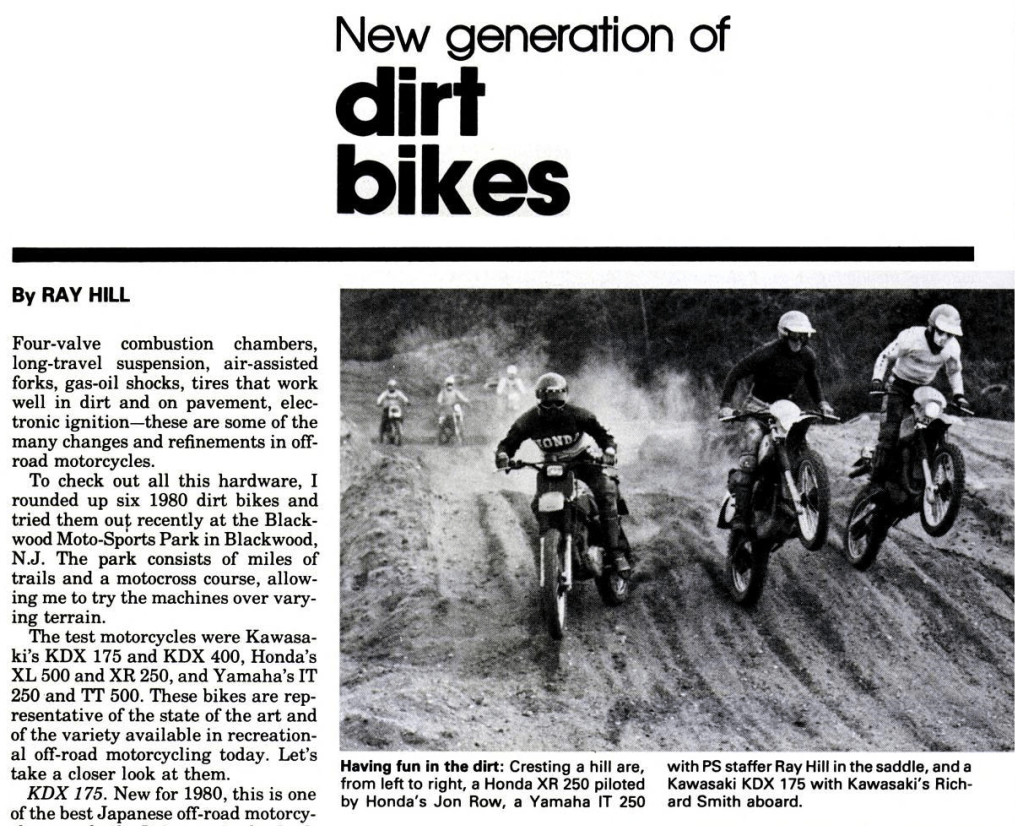
A survey of this land sees specks of the past that have just been waiting to be uncovered. There’s part of a faded fork boot here and a moldy shard of a shattered green plastic fender there. An old black bottle of Golden Spectro oil is buried by fallen leaves not far from another off-white container of Bel-Ray gear oil. The artifact that far outnumbered all the rest: used car tires.
Both sides of the serpentine course were, at its pinnacle, practically walled in with hundreds, if not a thousand, of the things. Laid end to end, they must have stretched for miles as the track slipped between sahara sands and native pinelands. These cracked and bald whitewall car tires – burnt by the sun, half-buried by the wind and strewn to rot – are all that’s left to place us back in the present day. Out in the woods, a tree has climbed to the sky straight up the center of one while another set was dug in long ago to firm up a jump.

Historic satellite images show that at some point between 1965 and 1970, excavators came along and dug out a rapid-absorbing layer of Cohansey sand made up of quartz, gravel and light-colored clay. It’s how many motocross riding spots came into existence during the heyday. Whatever those earth-movers were up to is completely lost to time, but a butterfly flapped its wings just above the treetops and here we are. Of all things to be mesmerized by, it’s this setting. The track, the pit, the people – the very things that bring riding to life. In the grand scheme of things, the legacy of Blackwood Moto Enduro is inconsequential. However, it’s the case study for the crucible of contemporary riding – not to mention what a dead-silent dirt bike might offer one day.
It all starts with these 140 acres. Millions of dollars have been exchanged for a stake in ownership. Everything from a firing range and an addiction recovery center to a cemetery and boat storage facility has been part of the picture, but the ground remained mostly unbroken for more than 40 years after the dirt bike club closed up shop. What seemingly failed to scare off prospective buyers is that this swath will forever sit uphill from a “Superfund” toxic landfill where federal dollars were sunk into much-needed remediation.
Environmental Protection Agency documents dating from the final years of the club – also around the time that the body of an alleged Philly mob hit victim turned up on the side of the road in 1984 under unrelated circumstances – show in great detail the deadly toxic refuse mostly illegally dumped here for a decade by out-of-state entities. The paragraph describing serious environmental and health risks to nearby homes and waterways posed by the unchecked landfill ends with this matter-of-fact statement that was hard not to laugh at: “a motorbike course occupies land to the west.”

Holy War
The Roman Catholic Church is recognized as likely the largest non-government landowner in the world. Its Catholic Youth Organization (CYO) facilities are intended to support sports and recreation. It’s no real big surprise then, given these two qualifiers, that this bit of property ended up in the church’s portfolio and became, quite literally, hallowed ground. Dune buggy drivers were the only ones using this clear-cut sand pit in the very early 1970s, so the pitchman behind Blackwood’s creation told me in 2025 that he approached the altar with an idea.
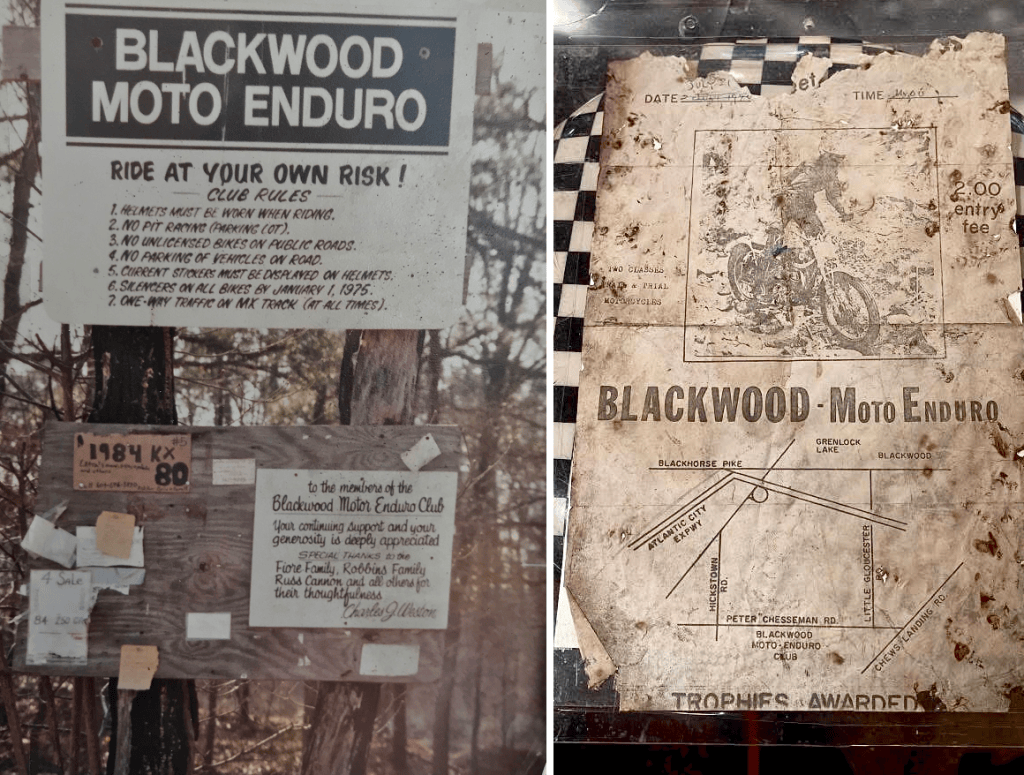
Under an agreement of $100 per month going to the local diocese that owned the land, and with help from the club’s first president who was a maintenance employee at the nearby CYO building, the effort to formally organize the chaos of pit riding began. The year was 1974 and in the process of all this planning, New Jersey’s first true off-road vehicle park with a membership-based system was launched. The earliest dues-paying members forked over $5, got a membership card and club sticker in exchange, then enjoyed the privilege of burning bean oil. A sweat-equity agreement meant hand tools would be used to groom the track, or they’d just run it in the reverse direction for a little while. This was the microcosm of early motocross in America: unwanted land located down a dirt road and not bothering anyone as it just kept organically growing.

‘It was the best place to practice in the state of New Jersey – an elite place to practice and train. It was well-organized, it was safe, and it was mobbed.’
“Back then, we rode anywhere,” said Glenn Robbins, a former pro motocrosser who put on two riding clinics at the old track and donated every dollar and then some back to plowing and bulldozing the whooped-out circuit. After all, this was his riding spot, too. What was unique about this dime-a-dozen pit was that its late president and founder worked for a neighboring religious youth program. After partnering with the club’s original pitch man and then convincing the Holy See to lease a portion of their land – with the non-profit organization officially hitting state books on Sept. 12, 1974 – an effort to formally organize the chaos of free riding began, Robbins said. This at least got everyone going in the same direction: “That was priceless to us.” Thus, the state’s first true off-road riding park with an annual membership-based system for a meager $5 per year was born. To hear his contemporaries say it, a Maico-mounted Robbins was a sight to behold and simply stupid fast in his day. “Go around the track and squeeze your grips as hard as you can,” he’d tell the students. “They’d come back and I’d ask ‘how do you feel?’ and they’d say ‘Terrible!’” He laughed heartily on our call. “Obviously! That was the idea,” he said of the 45-minute moto era.
If Robbins helped dial in the “moto” aspect, former Trail Rider Magazine publisher Paul Clipper’s allegiance eventually went to the “enduro” side of things. “Blackwood Moto Enduro was the place where I learned how to ride a dirt bike,” Clipper told me after I stumbled upon mention of a chilly New Year’s Day ride at “the pit” in his compilation book of “Last Over” columns. “The original track, which seemed to be all left-hand turns if you went the right way on the course, was improved over time and another group of guys arrowed out a set of tight ‘enduro’ trails that I thought was a lot more interesting than the MX course.” The whole thing “became a most comfortable place to hang out on the weekend” before broader horizons deep in the Jersey pines, and later California, appeared.
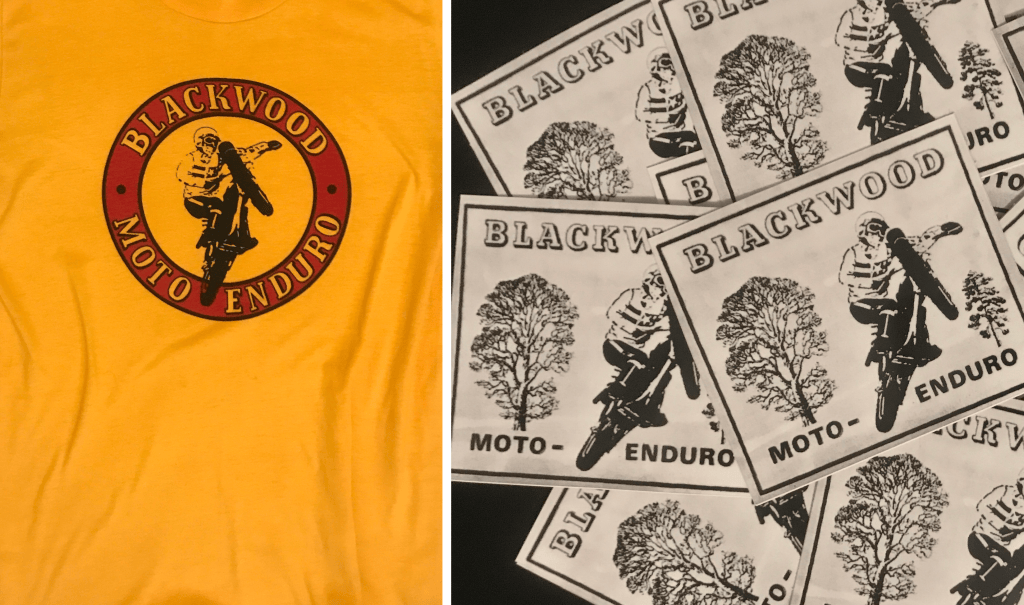
Clipper, barely a teenager around 1970 prior to the pit’s quasi-self-governing era, would beat up a stripped-down Suzuki TS250 Savage and Yamaha AT-1 with three older associates he’d met. The trio, with a hiking boots and blue jeans-clad Clipper in tow, took turns haplessly circulating the deep sand of the tire-lined track “falling down 12 times per lap, which of course means getting the bike back up, restarting it, and then railing off to the next corner. It didn’t take long to get tired at that rate,” he joked. They’d ride until exhaustion reigned and the poor primitive “all-purpose” bikes, sans lighting components, had been flogged within thousands-of-an-inch of usefulness. Blackwood introduced him to like-minded youth, old members taken too soon and woods riders who knew how to link trails together and cover as much diverse terrain as possible in a single ride. Ending 25 miles away at an old tavern didn’t hurt, the experience turning him into an “enduro rider for life.”
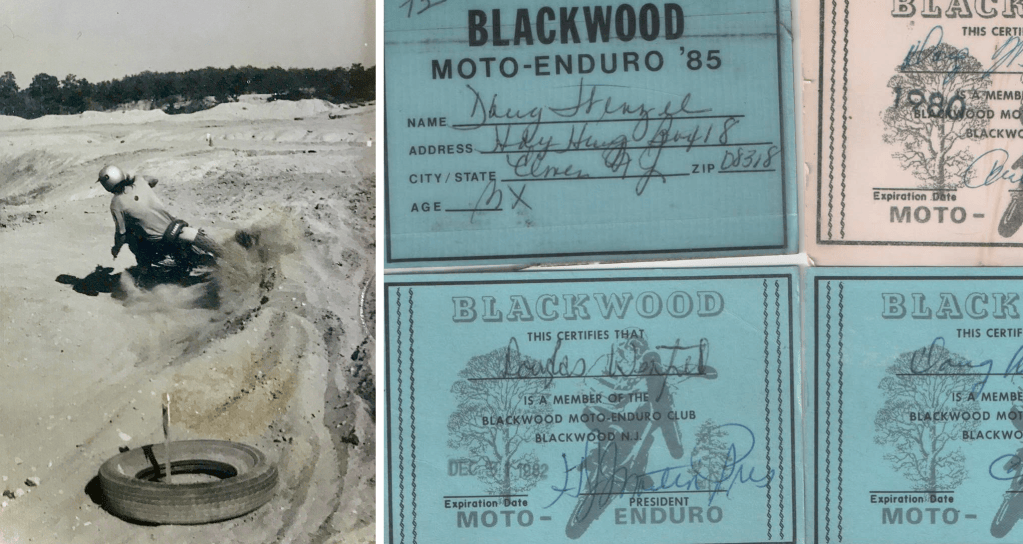
The final chapter was written in 1985. At the same time that club-carried insurance costs were starting to seriously spike, a non-local rider who supposedly wasn’t wearing the right gear went and got himself injured and lawyers got a whiff of blood in the water. The club was forced to defend itself against a lawsuit, despite having a robust insurance policy, but this mess put an end to the semi-religious experiment in dirt bike riding.
The lease ceased, the club folded and the ax finally fell six months later when a priest complained that people were still parking in the vicinity and riding there. The exodus took some across the street to a similar, but not quite as nice, option until that too was squashed and turned into a public park. Robbins’ last pro race was in 1978 at the Montreal Olympic Stadium and his final twist of the wrist at Blackwood was the early 1980s. He’s never been back, not even to look at what little is left, but the legacy is not the least bit diminished in his view. “It was well-organized, it was safe, and it was mobbed.” Emphasis his. Envy mine. “It was a little piece of heaven,” another former club member recalled for a 2022 article about off-road riding preservation. “There will never be a place like Blackwood again in the world we now live in.”
The Wasteland
The dead land. The cactus land. Across T.S. Eliot’s hollowed-out post-war wastelands, there’s sprawl between the act of actually doing something and the motions to make it happen. The possibilities offered by electric dirt bikes often sound too good to be true because they are, and we’re still not out of the proverbial woods yet.
The late Rick “Super Hunky” Sieman, Dirt Bike magazine founder and advocate of equitable access for off-road riding on under-utilized land, probably said it best. In a departure from his gonzo-like approach to motorcycles, publishing and pushing legal boundaries, “No Trespassing!” is a solemn column where you could tell it still stung. After passing a cacophony of kids on clapped-out dirt bikes tearing up some unused patch of vacant land, he thought back to when and where he first learned to ride. That spot, with its trash dump neighbor upwind, industrial refuse all around, and S-curves through the deep sand, was paradise tucked away in a secluded setting.
‘It made me think back to the days of when I was learning to ride a dirt bike. And it made me appreciate that vacant dirt lot a great deal.’
But the foreboding signs and barbed wire fences went up, as they seemingly always do, and the young riders were “threatened or thrown off that unused piece of land, for one reason or another.” Then, “like all of us at one time or another, they were threatened or thrown off that unused piece of land, for one reason or another.” All the good years that flew by culminated with one very bad day. The foreboding signs, threats of fines and barbed wire go up, and the morale goes down as an unused patch of dirt suddenly sits silent. “That night, and for a long time after,” Sieman wrote to close his column, “I felt very small and helpless.”
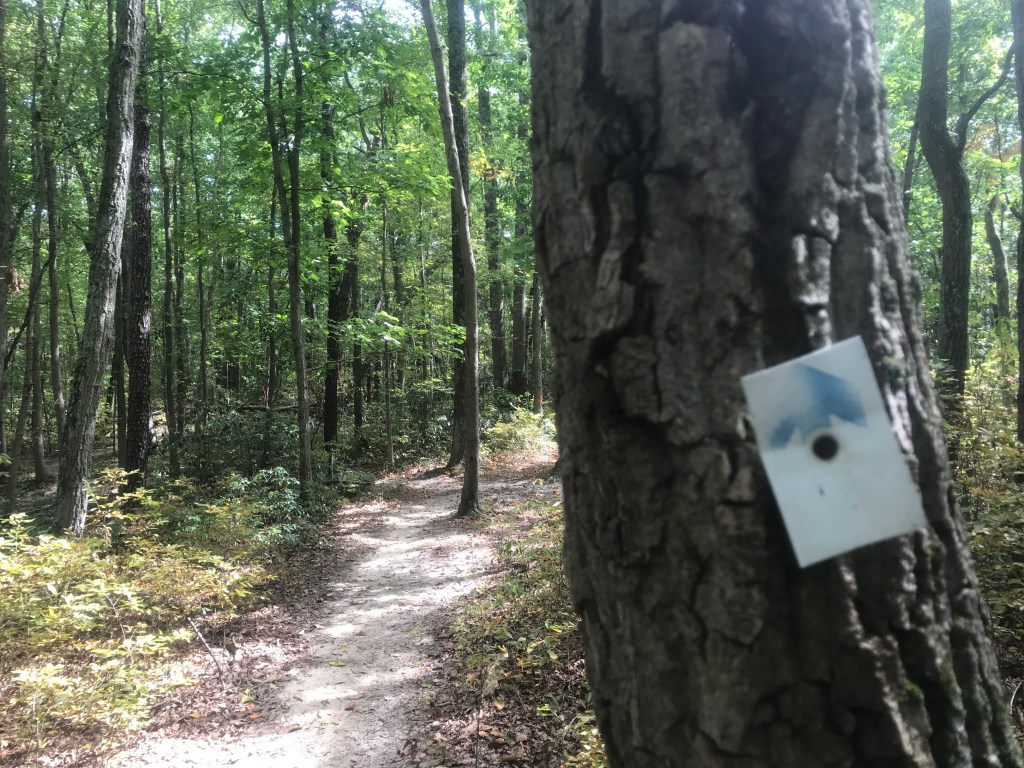
Not much remains these days of Blackwood, where bridges built long ago for creek crossings can still transport us to a timeless and solitary place. Pause and listen to the winds of war as they erode the berms, howl through hollow car tires, breeze between the towering pines, and rattle all those metallic enduro arrows still nailed up to tree trunks. These collected bits beg a single question. If, one day in the not-so-distant future, a bunch of electric dirt bikes churn up these sands of time but there’s no one the wiser to stop them, who really cares if it made a sound?


